
Rumi says: Don’t pretend to know something, you haven’t experienced yet.
I have read somewhere that it is not the experience which makes us to get better but the reflection on it.
The Kata enthusiasts will immediately relate this quote to something they know and believe, right?
But what is it that we want to reach and what is the business benefit of this approach?
Managers often highlight their most experienced experts as their key success factor: “20+/30+ years of experience”, “This person is here since the beginning”, “…knows everything about the topic…”, etc.
Is “time” the most important constant to develop this huge competencies and skills? This would be bitter.
These experts are extremely rare or mostly they are near to retirement age – imagine the cost of losing such intellectual capital. So what can we do about it?
And here comes the good news: Companies can create their subject matter experts in a much shorter time with a more diversified skillset!
Let me say in very simple words: If you as a Leader are not focused only to rescue this quarter or this year with the Lean implementation but focus on a long term mindset creation, establishing a real CI culture in the company then you have an advantage.
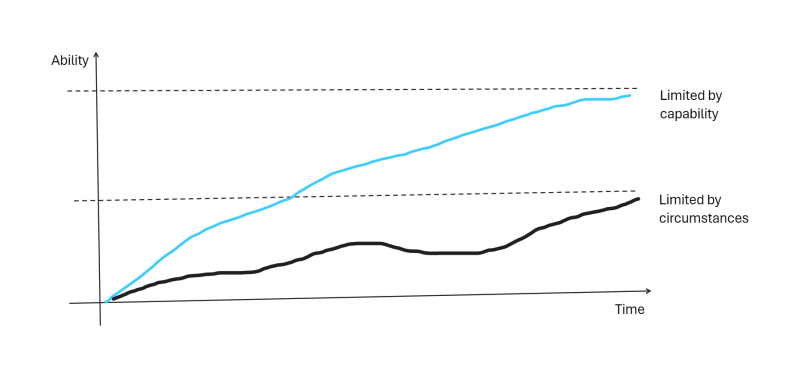
If we let our people gain their experience with weak or no structure, then these unstructured circumstances will be the natural limit for their development, it will take a huge amount of time and will be depending on a chain of coincidences.
With the right environment the only limit for the employees are their personal capabilities.
Below, I try to illustrate the difference. The curves are not based on any scientific research but personal observations.
The question is how to build up the structure and the processes to channel the activities to a path of “deliberate practice”?
In my previous blog entry I was trying to explain how we started to lay the foundation for it – the challenge is not only laying the right foundation but also making the people accept, even take the ownership of this environment as it needs to be continuously adapted & improved as well. My experience is that a leader shouldn’t pretend of knowing how things should be done best which is the biggest challenge because it is very much related to ego. Ego prevents you with high certainty of making significant progress. The caravan must be arranged on the way. This doesn’t mean chaos, you still have basic principles and your “northstar” but you don’t know the circumstances for your journey yet, so don’t pretend knowing it even if you are the caravan leader.
That’s why we didn’t take a Lean book to implement it but an approach which ensures an organic development through controlled and managed trial and error towards our northstar (“Enabling people to strive for excellence”)…and it looks very good, that’s also the reason why we started this blog .
Of course Mike Rother, Tilo Schwarz and some other experts are highlighting methodologies, guides how to establish such an environment but we are still working with human beings.
…and was it not Mike who said “All methods are wrong, some are useful”?
What's the use of a Lean Coach?
I recently visited a site that has progressed a lot in implementing Toyota Kata. We went to the morning routine and the operators were confidently reporting the issues of the last day, with the production manager leading the discussions and the shift leads taking notes and capturing problems. We reviewed the backlog of the plant and there was a nice flow of reported , addressed, and solved problems, with many quick fixes, some PDCAs and one or two projects. The whole time, the coordinator was proudly explaining that he most of these activities run without the need for him to intervene. We were quite close to the dream of our implementation – to make lean disappear by turning it into the natural, usual way the plant does business.
Improve before starting
The Humble Board Backlog
As I walked around the production area I could feel the change in the atmosphere. We have introduced the Toyota Kata method a few month before and at that time people were quite happy to see us. We could discuss issues from the board or issues that were not written on the board, the new process of handling them and so on. To put it in poetic way, there was hope in the air.
We do not have time to run 5S (just now)
If you are in the business of implementing Lean you have surely heard this sentence already. There were times, when I was a novice, when I even nodded to it and tried to work out a compromise. If not this month, how about next month? Or next quarter? Eventually we worked out a time and if pressure from upper management was strong enough, we even managed to have a 5S workshop. The results were rarely if ever sustainable, however.
The Critical Step
- “How committed are you to introducing Lean to the plant?” – the question came at the end of a job interview for the position of a Lean Leader for a factory.
Being everything and nothing
The role and responsibilities of a Lean Coordinator are various. We call them Lean Coordinators out of a principle which says “avoid everything what can indicate that daily business and continuous improvement are to separate actions”. Everyone in the organization should be a Lean Manager (long term vision) and the lean coordinator should be…coordinating the construction of the CI framework.
Why are PDCAs so hard?
Introducing Toyota Kata to a plant has two major components - the Improvement Kata and the Coaching Kata. The common root of both is the assumption that people working in the Toyota Kata way are PDCAs to work on problems and also are continuously being coached on how to improve thinking and working with PDCAs. This seems to be straightforward enough - after all what can be easier then to coach people to define a target first, list the impediments and then to pick one impediment at a time and start experimenting to eliminate it?
Learning more than what is taught
Our readers will remember my blog entry from March 2024 (“Expertise: by Luck or on Purpose”). There are different forms of learnings or better said, what the learner sees and grasps. Now there are some naturally talented people who always take more than they are taught, but this is the minority. It is understandable that there are also people who most probably are not performing their dream job, but just working to make a living, for whom this active learning may not be relevant. From an organization point of view this is one of the challenges, as they might not be the most motivated people in terms of CI. Taichi Ohno said, that their people come to work to think and not to work. The challenge lies in how to activate them to learn more than they experience or being taught as this particularly makes the difference.
The Face of Success
Nowadays, when I think about what a successful Lean implementation looks like I havethe face of one person for my eyes. For me this is what success looks like, so, please meet Kurt.
The great escalation
As I am naturally a risk seeking person, I took a risk in the beginning of our multisite Lean implementation program. Sometimes, if nothing else helps, you just have to let things happen with what you know now in order to get a picture about what you don’t know.
A Tale of Two Visits
I generally love to go Gemba and even more so when we visit a site where we implemented Toyota Kata. It is always very gratifying to see how the rituals start their life of their own, problems are regularly raised, discussed, and solved and how the engagement of the team members just shines through everything they tell us.
Kata and Culture
“So low did we sink” -said a member of the Steering Committee looking gloomily at everybody. We were sitting at our first monthly report-out of a new Ci initiative at the headquarters of the company and I just placed a large clock with very visible bells on top of it on the table and set it to 15 minutes. We already explained the new rule, that we need to keep the schedule and we have too much to discuss so that everybody is limited to 15 minutes to react to the topic under discussion.
Kommentar hinzufügen
Kommentare