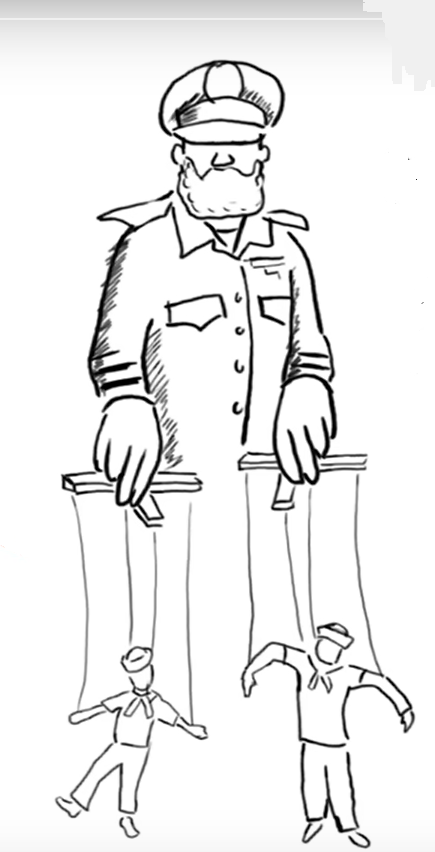
I have hesitated for quite some time before starting this blog entry. Until now all the stories were nicely optimistic and showed how to implement Toyota Kata . However, our title is “Kata in the wild” and I felt more and more that we also need to talk about failures. Unfortunately a Kata implementation can fail in the wild and it would not be honest to not talk about it. So, here it is, one story about failure:
We were sitting in the large meeting room of the company and listening to the site manager. We were amazed. Given the company background and what we knew about the company culture we did not expect so much knowledge and interest in modern management theory. Already at entering the meeting room we had our first pleasant surprise: there was a bookshelf in the room with many of our favorite books, and some unknown to us but with promising titles like “Begin with the End in Mind”, “The Goal” or “The Rational Manager”.
Explaining our brief from top management to introduce Lean management and especially the Toyota Kata was not so much a sales pitch as a meeting of fellow spirits. It almost felt superfluous to talk about Lean Management, we had the impression of meeting a need, our partner has had for a long time now and that we were welcome to finally help him achieve his personal vision and goal to turn this operation into a Lean textbook example. We left in high spirits happy to concentrate on other sites where we were met with a more cautious attitude (and also no Lean books in the meeting rooms).
A few weeks later we ran a Lean Awareness training with all the leadership team. Our friend from this site was not the most enthusiastic participant, probably due to the fact that we had nothing new to offer him. Still, he helped us in the group discussions to explain finer points and gave overall the impression of a committed supporter of our project. This was great help in convincing his fellow site managers to embark on the lean transformation.
Then, the day came when we started with implementing team boards and start collecting problems at the site. Our friend was too busy to participate at the first rounds, some unforeseen business emergency had to be responded to immediately. However the local lean coordinator with myself could confidently explain at every board that we have the full support of the site management. In one particular administrative office the team enthusiastically pounced on our idea with the board and asked us if rearranging the desks in the office could qualify for a small PDCA.
Clearly, this is not a high impact problem, but as a first step, to establish the confidence of the team, that their problems will be addressed and that they are now encouraged and empowered to propose solutions, this was a great starting point. I enthusiastically supported the idea to make this their first PDCA and even coached the first cycle. The idea was to rearrange the desks as they saw fit, collect feedback for a week and then, after the learnings were collected, either keep the new arrangement or change it and start a new PDCA cycle. In order to not give the impression that with PDCAs everybody starts running in several uncoordinated directions I also asked them to describe their intention and send the first PDCA document to the site manager before actually rearranging the office. They sent the email, we made a group photo in front of the board with 10 colleagues, shining with happiness, and we moved on.
Later on the day, with our work done I was sitting in a taxi towards the airport as I got an email from the lean coordinator. She simply, without comments, forwarded to me the answer of the site manager to the PDCA. It was a single sentence : “I understand, however, you will do EXACTLY as I tell you”.
This was a catastrophe. With this one sentence he destroyed the credibility of our lean coordinator, of the lean initiative and the hope of all the employees at the site that their problems will be listened to and as far as possible addressed. It forcefully pushed everyone back into the “business as usual” mindset.
I wrote a long email to the site manager explaining all this and asking him to allow the office to at least experiment with different arrangements of the tables. I explained, again, that the PDCA method does not exclude him from the solution finding, he can give his feedback and teach the team about aspects of the problem that they might not be aware of, so this could be a great learning opportunity for all of them. I never received any answer. The lean coordinator later told me that the site manager has already resigned his position and was spending his last days at the company. Clearly he had no interest in discussing PDCA theory with anyone.
Why did he destroy the Lean Initiative at the site, if he had no stake whatsoever in even working at the company? I don’t think my first gut reaction “this guy is the purest evil” is really the explanation. As Mike Rother found at Toyota, what really count in driving behavior are the unconscious reflexes and values each manager has. Someone can rationally be absolutely convinced that Toyota Kata is the right way to manage a site and even honestly complain about the colleagues who do not understand this . But then, there comes a moment when suddenly, unexpectedly these rational convictions are put to test. And in that moment deeply ingrained reflexes, values, ways of working with subalterns will take the upper hand. If a manager sees him- or herself as the sole person to decide and to bear the responsibility, this person will not even realize how much damage this attitude will do in in the everyday life of the organization. And, obviously, with this attitude, it is extremely difficult to retract an act or an email that resulted in so much damage.
What can we do in a such a case? I spent quite some time thinking about what I could have done differently in this case. Being on the lookout for early signs of the values and reflexes is definitely worthwhile, however training and exercises will only give a faint hint of a potential leadership problem. Defining binding standards around how to react to and how to manage the team-boards and the PDCAs will help, but not as much as one might think. Sometimes there is no other way, than to let the site fail and discuss the learnings and contrast it with sites that were successful. But no lean coordinator or coach will ever earn a thumbs up for this.
The starting picture is (again) from David Marquet's great video https://www.youtube.com/watch?v=psAXMqxwol8
Kommentar hinzufügen
Kommentare
At Toyota, practicing scientific thinking every day is a way of managing. However, we are learning that jumping right to deploying practice of scientific thinking as a facilitative/coaching managerial system may only work with those rare organizations who are already committed.
Mark Rosenthal and members of the Toyota Kata community are often using a different approach for getting started, which Mark describes nicely in this 10-minute video:
https://www.youtube.com/watch?v=wb5wW0ArA58
Essentially, you *begin* by infusing or interlacing a bit of scientific-thinking practice into a few activities the organization is *already doing* -- using one or two of the Toyota Kata Starter Kata -- rather than adding an all new activity. Makes a lot of sense.
(https://public.websites.umich.edu/~jmondisa/TK/KATA_Files/Starter_Kata_Flowchart.pdf)
I highly recommend watching Mark's video!