I asked this question the plant manager as we were leaving the regular morning meeting. I already spent a few mornings participating at the meetings as a “ghost” and the problems were already quite visible.
The meetings did not have a pleasant atmosphere. It was always the same pattern : first the production numbers for each line were written on a board with the deviation from the planned performance. Then, one at a time, the responsibles explained why the target was not reached (sometimes some reached the target, and they were skipped ). As the delinquent tried to explain the problem of the day, everybody else was just sitting passively, either glad that his ordeal was behind him or glad that he was not yet on the line. Every time the problem explained was due to something the responsible had no power over – suppliers, customers, maintenance budget, weather … you name it.
The plant manager then tried to suggest a solution to the problem. All involved took up a defensive position, crossed their arms and shook their heads. Obviously the suggested solution was no good. Someone then took the risk and explained the manager why his solution didn’t work. The manager thought a bit about it and came up with a different solution. Same ballet again, arms crossed, heads shaking sadly and another explanation coming forth, why this didn’t work either. Sometimes the manager even tried a third time but the in the end he just postponed the discussion for later and moved to the next guilty party .
It was after several such meetings that I asked the plant manager my question: you spend at least 10 waking hours a day in the plant. Is this how you want to live your life ? It does not have to be like it, you know.
The alternative is to build a team of responsible and creative people who, as a team, work on finding solutions to the problems. That is the ideal of Toyota Kata – to become an organization of problem solvers. And the first step on this road is to assume responsibility and to be willing to work on solutions. For the manager this is a risky step to make: he/she must empower the direct reports and accept the solutions they bring (if they work) even if he has better ideas. He will have to make a conscious effort to coach his team in problem solving and to transform himself into a coach and stop being a problem solver. He might even have to deal with toxic bosses higher up – I have heard the question “If your guys solved this problem, what do I pay you for?” more than once. The team might not want to be partner at first either. They might find their position as irresponsible leaders quite comfy. Or they might genuinely think that their role is to execute (and criticize) the boss's decision. As so much in the Kata world this will be a trial and error journey with failures, anger, sadness even shame. But once someone makes up his mind and commits to the vision of a cooperative responsible team of problem solvers, there will be no way back. There also will be successes, trust and cooperation, a great working atmosphere and people promoted from the team to higher positions. In a nutshell – work satisfaction .
I visited the same plant a few month later and participated to the morning meeting again. The first thing I noticed was that there were several new faces around the table. The second, that the discussion was much more flowing and the manager only intervened to direct this flow. About half the time ideas were coming from the team members. There was still some of the old blame game going on, but more often than not some other team member jumped in and moved the discussion back to a more productive track. There was a moment though when someone completely derailed the discussion and started to complain about their impossible situation. At this time the plant manager intervened. He did not suggest a solution, he just forcefully told this person, that the situation was well known to everyone, and that their job here was to find a way to cope with it. I could hear that this was not the first time he gave this message – and sure enough, after a little hurt silence the team went back to searching for solutions. At the end of the meeting, instead of scurrying away as earlier, they all stayed for a short time, had some laughs and a relaxed discussion.
As we were leaving, the manager looked at me with a broad grin on his face. I knew, he has made his choice. And no change of company initiatives or policies will take this from him, ever.
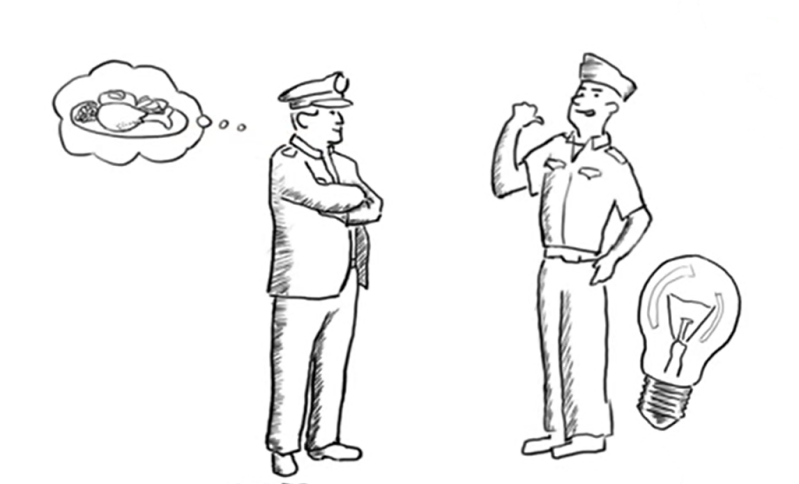
The starting pic is from David Marquet's great video on leadership https://www.youtube.com/watch?v=pYKH2uSax8U
Kommentar hinzufügen
Kommentare